There are some very talented acts in this segment--enjoy!
Despite recording this great song, this group could not come close to the success of their one big hit:
#190: Flamingos--"I Only Have Eyes For You"
Jacob and Ezekial Carey and cousins Paul Wilson and John E. Carter formed the Flamingos in Chicago, Illinois. Earl Lewis soon joined, and after several name changes (from the Swallows, El Flamingos and the Five Flamingos) the group became known as the Flamingos. Sollie McElroy replaced Lewis, and the group's first single on Chance Records was "If I Can't Have You". That song and "That's My Desire" were local successes, and Carter's song "Golden Teardrops" helped the Flamingos spread their fame regionally. The group switched to Parrot Records in 1954, then, after Nate Nelson replaced McElroy, the group signed with Checker Records. The group scored a #5 song on the segmented R&B chart in 1955 with "I'll Be Home". The Flamingos appeared in the 1956 movie Rock, Rock Rock. Zeke Carey and Carter were drafted into the United States Army later that year. Nelson, Jake Carey and Wilson continued the group with new member Tommy Hunt joining. Tenor, lead guitarist and arranger Terry Johnson also joined and the Flamingos began recording for Decca Records. Zeke Carey returned to the group in 1958, and the group switched labels once again to End Records. Johnson wrote "Lovers Never Say Goodbye" and the group recorded their first album Flamingo Serenade. The next single, "I Only Have Eyes for You", was a remake of a 1934 song that put the Flamingos on the map. The song reached #11 overall in the United States and was a #3 R&B hit. The group appeared in the movie Go, Johnny, Go, and became known for their stage show and choreography. But the group began falling apart by the end of the decade. Hunt left for a solo career, and Nelson and Johnson split to form the Modern Flamingos in 1961. Nelson eventually joined the Platters in 1966. New members were brought in, but the best the group could do after that was #26 in the U.K. with "The Boogaloo Party". The Flamingos received the Rhythm & Blues Foundation Pioneer Award in 1996 and were inducted into the Vocal Group Hall of Fame in 2000, the Rock and Roll Hall of Fame in 2001 and the Doo-Wop Hall of Fame in 2004. "I Only Have Eyes for You" was inducted into the Grammy Award Hall of Fame.
This group rode the car song craze of the 60's:
#189: Ronny & the Daytonas--"G.T.O."
This group formed in Nashville, Tennessee in 1964 and secured the services of Bill Justis ("Raunchy") as their manager. Paul Jensen (vocals and guitar), Thomas Ramey (bass, guitar), Lynn Williams (drums), Lee Kraft (songwriting, guitar) and John "Bucky" Wilkin (songwriting, guitar, vocals) were the original members. Ronny & the Daytonas signed to Mala Records and released "G.T.O." as their debut single. It hit #4 and sold over one million copies. A follow-up, "Bucket T" reached #54. But out of 15 singles, "G.T.O." was their only big hit.
Although this song talks of a "return", this artist had never had a hit before...nor since:
#188: Mark Morrison--"Return Of The Mack"
Here's the third single from the 1995 debut album for British R&B singer Mark Morrison. It rocketed up to #1 in the U.K., then spread around the world, reaching #2 in the United States and selling over two million copies.
Morrison was constantly in trouble with the law and was imprisoned in 1997. He attempted a comeback in 2006 but was not successful.
Here's one of those songs that almost everyone recognizes instantly:
#187: Mike Oldfield--"Tubular Bells"
Oldfield attended St. Edward's preparatory school and Presentation College in Reading, Berkshire, England. He began playing acoustic guitar in local folk clubs. Mike and his sister formed the folk duo the Sallyangie in 1967 and signed a recording contract with Transatlantic Records. The two released the album Children of the Sun in 1968.
Oldfield then joined a duo called Barefoot before playing bass and lead guitar for Kevin Ayers' backup group, the Whole World. Bandmate David Bedford encouraged Oldfield to develop a song he was working on called "Tubular Bells". Oldfield shopped the song to several record labels without luck.
Then, when Oldfield went to record his bass guitar part for the Arthur Louis Band, engineers Tom Newman and Simon Heyworth heard Oldfield's song and took it to Richard Branson, who was about to start Virgin Records. Oldfield signed a recording contract and recorded "Part One" of "Tubular Bells" in one week.
The Tubular Bells album was released as the inaugural album of Virgin Records. Oldfield played more than twenty different instruments on the project. The album sold over 2.6 million copies in the U.K. alone. The title track got significant exposure when it was included as music for the classic movie The Exorcist. The single reached #7 and won a Grammy Award for Best Instrumental Composition and is considered to be a forerunner of the New Age movement.
Oldfield's music was used as the musical score for The Space Movie that celebrated the tenth anniversary of the Apollo 11 mission. Mike's follow-up album, Hergest Ridge, reached #1 in the U.K. but, unlike its predecessor, success did not spread worldwide.
Oldfield made a transition to popular music and wrote songs for other artists, the best of these being "Family Man" in 1982 for Hall & Oates. Oldfield wrote the score for the movie The Killing Fields. Mike continued to explore new musical styles with The Songs of Distant Earth. In 1994, the asteroid 5656 Oldfield, was named after him.
Oldfield has released 27 albums and 47 singles in his career.
This artist sounds a lot like the Beach Boys. And interestingly enough, there's a Beach Boy tie-in involved:
#186: Henry Gross--"Shannon"
By the age of 14, this artist was performing regularly in New York clubs. While at Brooklyn College, Henry Gross co-founded the great 50's music revival group, Sha Na Na. The 18-year-old Gross was the youngest musician to perform at the legendary Woodstock Festival.
This song was written about the death of the dog of Beach Boys member Carl Wilson. While touring with the Beach Boys, Henry Gross visited Wilson's home and mentioned that he had an Irish Setter named Shannon. Wilson said that he too had an Irish Setter with that name who had recently been killed by a car.
"Shannon" hit #6 in the U.S. and was a #1 song in Canada and New Zealand.
Gross was able to bring "Springtime Mama" into position #37, but he could never reach the Top 20 again.
This artist sadly was never properly paid for his work 66 years ago and passed away in 2020:
#185: Phil Phillips--"Sea Of Love"
After performing the song "Sweet Slumber" at his school, Philip Baptiste was encouraged to pursue a singing career. He performed with his brothers in a gospel group known as the Gateway Quartet before recording "Sea Of Love" in 1959.
Baptiste changed his name to Phil Phillips and released the song on Khoury Records. But after the song began receiving heavy airplay, the song was leased to Mercury Records. "Sea of Love" reached #2 overall and #1 on the R&B chart and sold over one million copies.
But Phillips was only paid $6,800 and still has not received any further royalties for his huge hit. Because he fought for what was rightfully his, an album that Phillips recorded was not released. Del Shannon and the Honeydrippers both recorded cover versions of the song.
An association with the Beatles will forever keep this artist in the public mind:
#184: Terry Stafford--"Suspicion"
Stafford grew up in Amarillo, Texas, graduating from Palo Duro High School. After high school, Stafford moved to Los Angeles to pursue a music career.
Stafford released the single "Suspicion", which had been previously recorded by Elvis Presley, in 1964 and it reached #3 in the United States and #31 in the U.K. The song holds the distinction of being #6 on April 4 when the Beatles made history by holding down the entire top five. "Suspicion" sold over one million copies.
Stafford's follow-up single, "I'll Touch A Star" made it to #24, just shy of the Top 20 benchmark which defines a major hit. His 1973 composition "Amarillo by Morning" later became a huge hit in 1982 for country superstar George Strait.
Friendship with 2/5's of Fleetwood Mac helped this artist break through:
#183: Walter Egan--"Magnet & Steel"
In 1977, Egan signed a recording contract and recorded his first album, Fundamental Roll, produced by Lindsey Buckingham and Stevie Nicks. The following year, Egan released the album Not Shy, produced by Buckingham and Richard Dashut. Egan performed at the first Texas Jam in Dallas in front of 100,000 people along with acts such as Journey, Aerosmith, Van Halen, and friends Heart and Eddie Money.
Magnet And Steel", which featured backing vocals by Nicks, was released as a single and reached #8 in the United States and #32 in Australia.
Egan wrote the song "Hot Summer Nights" for the group Night and had a minor hit with it himself that is worth checking out. Walter released eight albums in his solo career. He later became a touring member in a later version of the group Spirit.
This artist recorded one of the big hits of 1967:
#182: Five Americans--"Western Union"
This group formed as the Mutineers in Durant, Oklahoma with lead singer Mike Rabon, John Durrill, Norm Ezell, bassist Jim Grant and Jimmy Wright on drums. Guitarist Robert Rambo, keyboardist Leonard Goldsmith later joined the Five Americans. They released "I See the Light" in 1966, which reached #26. "Evol-Not Love" reached #52 later that year.
Then in 1967, the group recorded "Western Union", which became a #5 song. Though they also had minor hits with "Sound Of Love" and "Zip Code" in 1967, "Western Union" was their only Top 20 hit out of 21 singles.
The Five Americans broke up in 1969. Rabon went on to sing lead and play guitar for Gladstone ("A Piece Of Paper" in 1972). Durrill wrote "Dark Lady" for Cher and also was a member of the touring group the Ventures.
Contributions of the members of this band went far beyond the group:
#181: Pilot--"Magic"
Pilot was formed in 1973 in Edinburgh, Scotland by David Paton and Billy Lyall, members of an early version of the Bay City Rollers. Stuart Tosh and Ian Bairnson joined the group and Pilot recorded several demos in 1973 and 1974.
The group signed a management deal with Nick and Tim Heath and John Cavanaugh and eventually inked a recording contract with EMI Records. In 1974, Pilot released the single "Magic" from their first album, a song written by Paton and produced by Alan Parsons. "Magic" reached #5 in the United States and #11 in the U.K.
A follow-up single, "January", reached #1 in the U.K. and Australia, but was only #87 in the U.S., and nothing further reached the Top 30. Paton, Tosh and Bairnson were members of the Alan Parsons Project, and Paton was a noted session musician, playing for Elton John and Rick Wakeman, among others.
Hope you enjoyed those 10. We'll be right here tomorrow with another great segment!
We're all set to present the best 200 One-Hit Wonders of the Rock Era*, based on the popularity of the song, both then and now, the talent, experience and level of musicianship of the artist, and in short, the "surprise factor" that the artist never had another hit. We started July 1, and we're now about to dive into The Top 200*...
We're up to one of the legendary songwriters of the Rock Era:
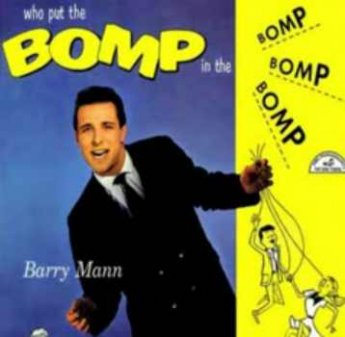
#200: Barry Mann--"Who Put The Bomp"
Mann signed on with Don Kirshner's and Al Nevin's Aldon Music, where he was a staff songwriter. Mann's first songwriting success was "She Say (Oom Dooby Doom)", a Top 20 hit for the Diamonds in 1959. In 1961, he co-wrote "I Love How You Love Me", a #5 song for the Paris Sisters.
Later that year, Mann recorded "Who Put The Bomp", which reached #7 in the United States. But rather than concentrate on becoming a solo artist, Mann continued to focus on his songwriting. He formed a partnership with Cynthia Weil, another of the songwriters at Aldon Music. The two married in 1961, and became one of The Top Songwriting Teams of the Rock Era*.
Together, Mann and Weil wrote "We Gotta' Get Out Of This Place" for the Animals", "Kicks" and "Hungry" for Boise, Idaho's Paul Revere & the Raiders, "On Broadway" for the Drifters, "Blame It On The Bossa Nova" for Eydie Gorme, "Walking In The Rain" by the Ronettes, "Uptown" for the Crystals" and "Magic Town" for the Vogues in their early years. Mann and Weil teamed with Phil Spector to write the #1 classic "You've Lost That Lovin' Feelin'" for the Righteous Brothers, which became the most-played song of the 20th century. Mann and Weil also wrote another huge hit for the Righteous Brothers--"(You're My) Soul And Inspiration".
Mann and Weil also wrote "Somewhere Out There" for Linda Ronstadt and James Ingram. The song reached #2, sold over one million copies and won two Grammy Awards. Ronstadt and Aaron Neville turned Mann and Weil's "Don't Know Much" into another huge hit. The two also wrote "You Take My Breath Away" for Berlin for the movie Top Gun.
Other Mann-Weil hits include "Just Once" by James Ingram & Quincy Jones, "Never Gonna' Let You Go" by Sergio Mendes, "I Just Can't Help Believing" and "Rock And Roll Lullabye" by B.J. Thomas, "Here You Come Again" by Dolly Parton and "Make Your Own Kind Of Music" by Mama Cass Elliott.
Mann has now written over 635 songs. He has received 56 awards from BMI and 46 of his compositions have gone over one million airplays. In 1987, Mann and Weil were inducted into the Songwriters Hall of Fame and in 2011, the two received the Johnny Mercer Award, the highest honor from that organization. In 2010, Mann and Weil received the Ahmet Ertegun Award from the Rock and Roll Hall of fame. Today, Mann and Weil own their own publishing company called Dyad Music.
While Mann may have been a One-Hit Wonder as a recording artist, he has made monumental contributions to the Rock Era as one of its top songwriters.
At #199, yet another award-winner featured in our special:
#199: H-Town--"Knockin' Da Boots"
Twins Kevin "Dino" Conner and Solomon "Shazam" Conner sang in talent shows and plays before a local producer sent a demo tape to Luther Campbell. The brothers joined Adrian Washington and Darryl Jackson and formed H-Town in 1992. The group named themselves from the local nickname for the city of Houston, Texas in which they grew up. After an audition, Campbell signed the group to the label Luke Records.
H-Town's debut album Fever for Da Flavor was released in 1993 and featured the single "Knockin' Da Boots". The song hit #1 on the R&B chart and was #3 overall and helped the group win the Soul Train Music Award for Best New Artist. They performed on the Coca-Cola Summerfest tour, which also included SWV, LL Cool J, Shai, Jade and Silk.
But the best track on their second album Beggin' After Dark was "Emotions", which reached #51. H-Town did not hit the Top 20 again, with the best attempt being the remake of the Persuaders' "A Thin Line Between Love And Hate", which reached #37.
H-Town released six albums and 10 singles in their career.
He could have been a lawyer but his fate was entwined with rock and roll history:
#198: Big Bopper--"Chantilly Lace"
J.P. Richardson graduated from Beaumont High School in 1947. He studied pre-law at Lamar College and was a member of the band and chorus. Richardson also played with the Johnny Lampson Combo.
Richardson worked part-time at KTRM radio in Beaumont before being hired full-time in 1949. He was drafted into the United States Army in 1955, and served as a radar instructor in El Paso, Texas.
After his discharge in 1957, Richardson returned to KTRM, where he did the afternoon shift from 3 to 6 and began to call himself "The Big Bopper".
Richardson played guitar and began his career as a songwriter, writing "White Lightning" for George Jones and "Running Bear", a song that became #1 for Johnny Preston. Harold "Pappy" Daily of Mercury Records signed Richardson to a recording contract buJ.P.'s first single, "Beggar To A King" flopped. He then recorded "Chantilly Lace" as the Big Bopper, which was released in 1958 and reached #6.
Through the success of "Chantilly Lace", Richardson was invited to join Buddy Holly, Ritchie Valens and Dion and the Belmonts for the Winter Dance Party, a tour that took the artists all over the Midwest.
Richardson died on the 11th night of that tour on February 3, 1959, a day that we know as The Day the Music Died, killed in a plane crash in Iowa along with Holly and Valens.
Another Tony Burrows project is up next:
#197: Edison Lighthouse--" Love Grows (Where My Rosemary Goes)"
Edison Lighthouse originally consisted of lead singer Tony Burrows, Stuart Edwards on lead guitar, David Taylor on bass, drummer George Weyman and guitarist Ray Dorey. Burrows had the distinction of singing lead on four songs that were out nearly at the same time: "My Baby Loves Lovin'" by White Plains, "Gimme Dat Ding" by the Pipkins and "United We Stand" from Brotherhood of Man, in addition to this one.
"Love Grows (Where My Rosemary Goes) was #1 for five weeks in the U.K. and #5 in the United States, selling over one million copies. Burrows left to pursue other projects and the rest of the group could not play live. Another group of musicians was assembled to record using the name, but the best this second edition could do was the Top 50 in the U.K. with "It's Up to You, Petula".
Burrows also sang lead on "Beach Baby" in 1974, a hit for the First Class.
They may call it "Alternative Rock", but this group hit the Mainstream with this song:
#196: Semisonic--"Closing Time"
After the breakup of the group Trip Shakespeare, lead singer and guitarist Dan Wilson and bassist John Munson joined with drummer Jacob Slichter to form Semisonic in Minneapolis, Minnesota in 1995. The group released the EP Pleasure that year on CherryDisc Records and then released their debut album Great Divide on MCA.
Two years later, Semisonic's second album, Feeling Strangely Fine, contained the single "Closing Time". The song reached #11 overall and #1 on the Alternative Rock chart in the United States and #25 in the U.K. The album Secret Smile reached #13 in the U.K. but did not even make the Top 100 in the United States. Future efforts were not as successful despite extensive tours.
There are two "Show Me Love"'s by a Robin (one is spelled Robyn) and both are great. That one enjoyed several other hits so is not a One-Hit Wonder but this one is one of the best!
#195: Robin S.--"Show Me Love"
Robin S. signed a recording contract with Big Beat Records in 1994. Her debut single "Show Me Love", the title track on her album, was a #1 Dance song, #7 R&B and #5 overall in the United States and #6 in the U.K.
After taking time off to write songs, Robin began working on her album From Now On. "It Must Be Love" was another #1 Dance song but only #91 overall. "Midnight" was yet another #1 in the dance music genre but failed to make the Top 20, only reaching #35.
Robin S. released nine singles in her career.
This group formed the foundation for one of The Top Soul Groups of the 1970's*:
#194: American Breed--"Bend Me, Shape Me"
This group first formed as Gary & the Nite Lites in Cicero, Illinois. The original members were lead singer Gary Loizzo, bassist Charles Colbert, Jr., Al Ciner on guitar and Lee Graziano on drums. Gary & the Nite Lites released one single and built a local following.
The group underwent several changes, signing with Acta Records and changing their name to the American Breed.
Their single "Bend Me, Shape Me" in 1967 was a remake of a song done by the Outsiders the previous year. The American Breed reached #5 in the United States and #24 in the U.K. with the song and promoted it by appearing on American Bandstand. "Bend Me, Shape Me" sold over one million copies.
The group charted four other singles besides their One-Hit Wonder, but nothing that approached it in success. In years to come, they shortened their name to the Breed, then Smoke, before evolving into the group Ask Rufus. They then added singer Paulette McWilliams, who was later replaced by Chaka Khan, and the group became Rufus.
This song not only led to our next group signing a recording contract but gave them their one big hit:
#193: When in Rome--"The Promise"
When some members of the Manchester, England group Beau Leisure left, vocalist Clive Farrington recruited keyboardist Michael Floreale and vocalist Andy O'Connell. Floreale and Farrington began writing songs and later invited singer Andrew Mann to join the group. When O'Connell left the group, the remaining trio began recording demos.
The band signed with 10 Records, a subsidiary of Virgin. Ben Rogan (Sade's producer) and Richard James Burgess were interested in a song called "The Promise". When the 12" single hit #1 on the Dance chart, Virgin ordered an album. "The Promise" was released as the first single from When In Rome's debut album and reached #11.
However, #95 was the best the group could do after that with "Heaven Knows" and subsequent singles were not successful. In 1990, When In Rome broke up over musical differences.
By listening to this song, you'd think the outlook was miles ahead of other groups out right now, and you'd be right:
#192: New Radicals--"You Always Get What You Give"
Lead singer Gregg Alexander organized the New Radicals in Los Angeles in 1997 after releasing two unsuccessful solo albums. The following year, the group signed with MCA Records. Alexander wrote and produced all of the group's music. The New Radicals was essentially Alexander and a revolving door of musicians. Former child actress Danielle Briseboi (All in the Family) was the background singer and percussionist on their album and at live performances. The New Radicals released just one album, Maybe You've Been Brainwashed Too, in 1998 that went platinum as a result of their one hit.
The single "You Get What You Give" reached #1 in Canada and New Zealand, the Top 5 in the U.K., and #36 in the United States. The group toured extensively in the United States until Alexander broke up the group in 1999 to focus on writing and producing songs for other artists. Alexander worked with Rod Stewart and Enrique Iglesias and wrote and produced "The Game of Love" for Santana and Michelle Branch.
This duo wrote this song as an expression of the deep love they had for their city:
#191: Cashman & West--"American City Suite"
Terry Cashman was lead singer for the Chevrons in the late 1950's, and also played minor league baseball in the Detroit Tigers organization. In 1967, he joined Gene Pistilli and Tommy West to form the group Cashman, Pistilli and West. Cashman and Pistilli wrote "Sunday Will Never Be the Same", a hit for Spanky and Our Gang.
Pistilli left and the group was changed to the duo Cashman & West. They recorded six albums, with "American City Suite" being their only big success. It was highly underrated at #27 in the United States and #25 in Canada.
Cashman and Pistilli also had a #22 song "Medicine Man" as the Buchanan Brothers. Cashman and West produced Jim Croce's songs in the early 1970's. In 1975, the pair began Lifesong Records, which would lead to songs like "Shannon" from Henry Gross.
These artists we're saluting: you hear their songs and just shake your head--"why didn't they make it?" That really goes for Cashman and West--what a composition; great lyrics, great music, great instrumentation--it really is a mystery how they didn't do more! We've got 190 more of those, exclusively on Inside The Rock Era!